

Legend has it that Rudolfine alchemists produced gold and the elixir of youth here. The reality was perhaps a little simpler, but no less fascinating. Yes, we are talking about Golden Lane near Daliborka at Prague Castle, a place where history mixes with myths in every cobblestone. Why are the houses so small? Who actually lived here, and why did the lane become a symbol of Prague’s magic?
Few places in Prague can transport you to another century as instantly as Golden Lane. Nestled between the walls of Prague Castle, with its dwarf houses and brightly colored facades, it looks more like a fairy-tale backdrop than a real street where people once lived.

Come with me on a journey in the footsteps of castle archers, alchemists, and Franz Kafka, and uncover the secrets hidden behind the smallest doors in Prague. For centuries, this alley has been a unique, bizarre microcosm unto itself.

WHY IS IT CALLED GOLDEN LANE?
Golden Lane is a narrow, colorful, and charming alley located within the grounds of Prague Castle, one of the most important historical sites in the Czech Republic. According to legend, goldsmiths and alchemists lived here in the Middle Ages, allegedly trying to find the philosopher’s stone and make gold. According to some sources, it was an ironic name for a poor neighborhood, or possibly a reference to the color of sewage (urine and feces) that polluted the street. Although the truth is less romantic, it was simply the dwelling place of castle guards and workers. The name Golden Lane has remained and given this place a mysterious and magical touch that attracts tourists from all over the world.

WHAT WILL YOU SEE WHEN YOU VISIT GOLDEN LANE?
TODAY´S APPEARANCE WAS INFLUENCED BY ARTIST JIŘÍ TRNKA
Golden Lane consists of a row of small houses with colorful facades, which today serve as a museum and showcase of life in the Middle Ages and early modern times. Some of the houses are furnished as workshops or shops, while others resemble the apartments of the inhabitants of that time. The current appearance of Golden Lane was significantly influenced by the famous artist Jiří Trnka. The facades of the houses were painted according to his design from the 1950s.


MY TIP:
Did you know that you can visit Golden Lane for free?
Golden Lane is open year-round and is part of the Prague Castle tour. The best time to visit is in the morning or late afternoon, when there are fewer tourists and you can enjoy the atmosphere in peace. Admission to Golden Lane is included in the castle ticket, but after 5 p.m. admission is free, although you cannot enter the houses. However, it is ideal for a romantic evening stroll. And that’s worth it, isn’t it? 🙂
A LITTLE HISTORY NEVER HURT ANYONE
Golden Lane was established at the end of the 16th century during the reign of Rudolf II, when it was built as a base for the castle archers. They performed a similar function to today’s castle guards, and their name came from the characteristic color of their uniforms. The small houses were adjacent to the inner wall, which explains their unusually low height and narrow space. Since all construction work was carried out at their own expense, they could do with them as they pleased. And so, gradually, various people who did not belong to the castle garrison, but mainly to the poorest castle servants, took up residence here. And so, Golden Lane lived its own life.

Later, craftsmen, merchants, and legendary alchemists moved here, and this is where the name “Zlatá” (Golden) comes from, even though no gold was ever mined or smelted here. Even so, this street is said to have magical energy, and many visitors like to return here again and again. I do too. 🙂
The houses were inhabited until World War II. Even during the First Republic, care was taken to ensure that the street did not lose its beautiful character during renovations. The last residents moved out in 1953. The houses were bought by the Office of the President of the Czechoslovak Republic.

HOUSES OF GOLDEN LANE
Just as curious as Golden Lane itself was the community of its inhabitants and their fates. The miniature houses were mainly home to those who had been forced there by their professional status, poverty, or artistic interests. In its immediate vicinity, convicts served their sentences in the towers.

And so Golden Lane became a colorful mix of residents, from soldiers, shoemakers, laundresses, and merchants to occultists, poets, and fantasists. It is precisely this concentration of characters, professions, and legends that gives the place its unique atmosphere.
HOW IT LOOKED INSIDE
The individual houses looked pretty much the same. From the outside, you entered a small hallway, which often had a fireplace with a chimney, so it also served as a kitchen. There was a hatch in the floor that led to a cellar, which was used to store basic foodstuffs. The ceiling of the hallway consisted of a folding door, through which you could climb a folding ladder or steps to the next floor. This was basically just a ceiling, and it is clear that it was a very cramped space. However, this did not bother random overnight guests, who were happy to have a place to sleep at all. From the hallway, you could enter the only room, which was about 15 m². It was lit by a single window, from which the luckier ones had a view of the Deer Moat, while the less fortunate ones only had a view of a tree.

The owners of the houses went to one of the castle fountains to get water, although later water pipes were installed in the alley, so there was a pump there. The sanitary facilities consisted of one official toilet shared by all residents of the alley, located at No. 13.
WHO LIVED HERE?

Today, Golden Lane serves as a living museum where you can peek inside the interiors of individual houses. Each one has its own story. Come with me and see the most interesting ones.
House No. 6 – a house that is no longer here

You won’t find this house here, but let’s tell its short story. It stood in the neighborhood of the Supreme Burgrave’s House, and its roof reached the height of the sidewalk in Golden Lane. In the 1960s, it was demolished during construction work in this part of the Castle. Shortly before World War II, the poet Jaroslav Seifert lived there.
House No. 12 – Home of amateur historian J. Kazda (1950s)
Josef Kazda was an amateur film collector and historian. His lifelong interest in cinematography soon made him one of the leading experts on Czechoslovak and American film.


During World War II, he was instrumental in saving many copies of Czech films that had been removed from distribution by order of the German occupiers. Thanks to him, a large number of silent and lesser-known documentary films have been preserved. When his company Komedia Film had to cease operations, he was forced to rent several inconspicuous places where he stored the material. One of those “inconspicuous places” was a small house in Golden lane.

Famous artists such as Jiří Trnka, Jiří Brdečka, Jan Werich, Eduard Hofman, and many others used to visit him here. Mr. Kazda organized various lectures and screenings here throughout the week. His wife cooked delicious soups for the guests.


In the 1960s, Mr. Kazda worked in the identification commission of the National Film Archive. Thanks to his efforts, he was able to identify anonymous actors and situations in many photographs and negatives that only true eyewitnesses of that time could recognize.


The staircase in this house leads to the terrace in front of Daliborka. This cylindrical cannon tower was part of the Jagiellonian fortifications, and its lower floor served as a prison from the beginning. The first and most famous prisoner was the knight Dalibor of Kozojedy in 1498.
House No. 13 – Residence of the castle archer
(late Renaissance)
House No. 13 is unique in that it is the smallest in Prague Castle, but also in the whole of Prague. It was home to the castle archers, the ancient predecessors of the Castle Guard. They wore distinctive red uniforms. They performed their duties without a fixed salary, receiving only tax exemptions and the benefit of living within the grounds of Prague Castle. There were 24 red guards, who were subordinate to the castle governor.

In 1597, they asked Rudolf II for permission to brick up the niches in the newly repaired city walls and set up small rooms there. The emperor granted the archers’ request. Their most important source of income was the services they provided to nobles imprisoned in the White Tower and Daliborka. They worked for them as servants, cooks, stokers, nurses, or mail carriers. Their official uniforms and the opportunity to earn extra money aroused envy among the other castle servants, who gave them the nickname “holomci” (bums). At the request of the governor, a fine was imposed for using this nickname.
Their service ended during the reign of Emperor Joseph II in 1784. He sought to reduce court and administrative expenses, which led to the abolition of many traditional corps. Just as he abolished monasteries that were not involved in education or healthcare, he also restricted other institutions that he did not consider useful.
House No. 14 – The House of the Clairvoyant Průšová
(first half of the 20th century)
The blue house numbered 14, with a sign featuring an owl, crystal ball, playing cards, and cat, was home to the renowned Prague fortune teller, card reader, and clairvoyant “Madame de Thébes” before World War II. This pharmacist’s widow, whose real name was Matylda Průšová, attracted attention from afar with her black clothes and old-fashioned hat with ostrich feathers. Customers came daily to her small room, crammed with bizarre objects, including stuffed owls and a wooden eagle hanging from the low ceiling, with a desire to glimpse into the future. Mrs. Průšová’s clientele reached as far as overseas. She received numerous letters from Cape Town, for example.

This mysterious lady made protective talismans and herbal mixtures. She was known as the local herbalist who gathered medicinal plants on the slopes below the castle. In her cottage, she mixed teas, healing ointments, and amulets for “cleansing the soul.” The local children loved her, but the adults were sometimes afraid of her. Today, they would call her a “witch with good karma.”

She was also a famous fortune teller. Unfortunately, she met a tragic end because she predicted the fall of the Third Reich and Hitler. For this reason, she was arrested by the Gestapo and tortured to death during her final interrogation.


Today, the cottage is furnished as a medieval herbalist’s workshop.
House No. 15 – Goldsmith’s workshop and residence (Renaissance)
The original name “Zlatnická” (Golden) first appeared in the 1560s. It stems from the fact that the inhabitants of some of the houses were small goldsmiths and gold smiths who fled here to escape guild laws. Goldsmithing flourished in Prague at the end of the 15th century during the reign of the Jagiellonian dynasty, when workshops were established on the Old Castle Stairs and in Golden Lane, among other places.

The goldsmiths from the alley were always among the poorer representatives of their craft. They accepted smaller orders, which included jewelry to adorn clothing, cutlery, decorated chains, and the cutting of seals and coin stamps. There was also interest in rosaries, which were wrapped around the wrist or fastened around the waist.


No goldsmith’s workshop was complete without a cage containing a live bird, which served as a natural detector of poisonous fumes from the chemicals used in the work.

House No. 16 – Brewery and Pub
The operation of taverns and beer bars has been successful at Prague Castle since time immemorial. Taverns sprang up in many places, such as Vikářská Street, the Old Royal Palace, and, of course, Golden Lane. And this is where life really happened. Sly jugglers and musicians frequented these places.

When the revelry got underway, peddlers of small goods, known as “šmějdíři,” would come to the tavern. People would play dice or cards here.

House No. 19 – House “U Trojice”
House No. 19 in Golden Lane at Prague Castle was formerly known as “U Trojice” (At the Trinity) and today serves as a shop selling traditional Czech goods. The house was built in the 16th century as a residence for castle archers and later housed small craftsmen. Like the other houses in the street, No. 19 has retained its Renaissance character with small windows and low ceilings.

At Olga Havlová’s request, house no. 19 has been home to a gallery selling souvenirs from sheltered workshops where people with disabilities work since 1993.

Postcards, pictures and greeting cards painted by children, small ceramics, seasonal decorations, and textile products are sold here. The gallery cooperates with several dozen suppliers.
House No. 20 – The Last Resident of Golden Lane
Mrs. Drašnarová lived in this house, the last resident of the street, who remained here until 1952, when Golden Lane was opened to the public. Her house is reminiscent of everyday life in the first half of the 20th century.

Mrs. Marie Drašnarová was the last “civilian” resident of Golden Lane. She lived to see the area finally transformed into a historic preservation zone. She recalled how children played hide-and-seek between the houses and how neighbors invited each other over for coffee.

House No. 22 – where writer Franz Kafka worked
Probably the most famous house on the entire street. Between 1916 and 1917, the famous writer Franz Kafka stayed and worked here. He did not live here permanently, but worked in his study, which was provided by his sister Ottla.
He mainly wrote short stories and short texts here. The silence, tranquility, and secluded world of the street suited him. Among other things, parts of the work In the Penal Colony were written here. Although he only lived here for a year, the street is still referred to as “Kafka’s Street” today.


Today, there is a small shop inside selling literature and souvenirs.


Another tenant from the beginning of World War II was the publisher of Aventina, Otakar Štorch-Marien. Close friends such as Jiří Trnka, Vítězslav Nezval, Jaromír Funke, and others often visited him in his cramped dwelling. Austrian Jewish writer Erwin Weill drew inspiration for his “Tales from Golden Lane” here before being sent to a concentration camp.


Another article about Franz Kafka:

House No. 24 – Armory
At the end of the alley, there is a small passageway leading to a weapons museum, where you will find armor, swords, and crossbows. The house also recalls the era of Rudolf II’s alchemists, who are said to have searched for the elixir of immortality in these very places.


At the very end of Golden Lane lived Mr. Otto Kokoška, a man who spent his entire life collecting cold weapons and armor. He had a collection of swords, halberds, and helmets from various periods, which he stored right in his living room. Today, his collection forms the basis of the armory exhibition housed in house no. 24. He was an eccentric, but beloved. He often showed children how to hold a sword and told stories about knights.


House No. 24 – Mrs. Magdaléna’s House
(First Republic)
At the beginning of the last century, the residents of Golden Lane were aware that their houses had a special charm and uniqueness. As society’s admiration for historical monuments and thus for old Prague grew, Golden Lane also became famous. In order to increase the attractiveness of their homes for the ever-growing number of tourists, they began to renovate their houses. The small rooms began to be transformed into rooms with wooden floors and tiled stoves to make them look more “gentlemanly.”

Furniture of various styles was added, and curtains appeared on the windows. The walls were painted in appealing colors and family photographs and homemade embroidery were hung on them. They competed with each other in beautifying their homes, which in many cases they did not even live in. Every day, they would come to the alley from their more comfortable apartments in Prague and open their houses to visitors. Like Mrs. Magdaléna, they allowed them to look inside their homes for a few coins. The more enterprising ones rented them out to artists or writers who sought inspiration for their work here.


As I mentioned earlier, in 1953, the Office of the President of the Republic purchased the houses from their original owners.
House No. 26 – Seamstress’s Room (First Republic)
Seamstress was also a sought-after profession among servants. During the royal court’s stay at the Castle, but especially after its departure, there was always something to mend, sew, or even make. In addition to repairing linen, the seamstresses in Golden Lane also sewed dresses, mainly for customers from the poorer sections of the Castle and its immediate surroundings.


In their “salons,” they mainly re-sewed clothes, because clothes were worn for a long time, and if they went out of fashion, it was worth reworking them. Only when there was no further use for the clothing was it sold to a junk dealer.


In the parlour, you will also find an old gramophone, which is intended to remind you of old songs that praised Prague, its inhabitants, and its monuments. They were written by a popular Prague actor, songwriter, and cabaret artist of the interwar period.
House No. 27 – The Herbalist’s House (late Baroque)
The ability to treat wounds, cure illnesses, and provide assistance to those in pain. This was an indispensable skill that someone among the castle servants always possessed. Such folk healers and herbalists often only needed proof that they had successfully cured someone in order to practice. Their services were used not only by castle workers, but also by the nobility.


In addition to a rational approach, healers also used magic and incantations. However, the most commonly used method was herbs. The fact that herbs have healing powers was reinforced by herbals. One of the most popular was Mattioli’s herbal. It was translated in 1562 by Tadeáš Hájek z Hájku.


The herbalist’s house resembled an apothecary. And what could you find there? Bottles, jugs, and boxes full of plant-based honey, potions, and opiates. There were also tooth powders and such curiosities as pig teeth, sea spider bones, and dried frogs. Ceramic pots contained dog, rabbit, bear, and snake fat.


The House at the Last Lantern
The House at the Last Lantern is a mystical house which, according to the legends of German writer and occultist Gustav Meyrink, only exists under certain conditions. Otherwise, it appears to be part of the city wall and represents a gateway to a magical, “second” Prague.
It is said that by crossing the threshold of this house, you can enter other, perhaps parallel worlds. A clue in your search may be the fact that there really was a small house in Golden Lane where an alchemist unknown to us lived. This house only appears sometimes and only to some people.
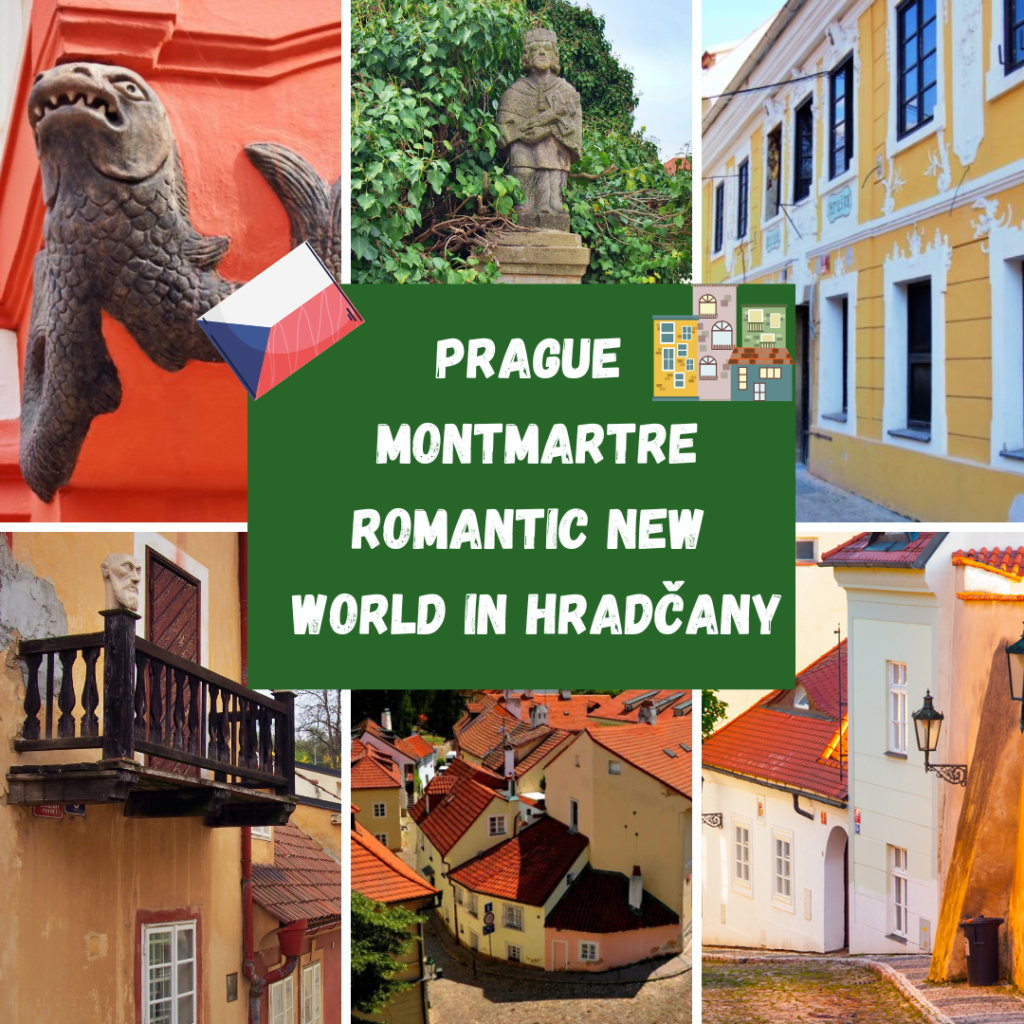
Golden Lane was apparently not even a center for alchemists. They mainly gathered in Pohořelec or in one of the most picturesque parts of Hradčany, called Nový svět (New World). The famous Tycho Brahe, who was also closely associated with alchemy, lived here.
Another article about the New World
PRACTICAL INFORMATION
Admission to Golden Lane: Golden Lane is part of Prague Castle Tour B, which also includes St. Vitus Cathedral, the Old Royal Palace, and St. George’s Basilica.
Opening hours:
Summer season (April–October): 9:00 a.m.–5:00 p.m.
Winter season (November–March): 9:00 a.m.–4:00 p.m.
Best time to visit: Early in the morning or late in the afternoon, when there are fewer tourists and the light is best for taking photos.

HOW TO GET TO GOLDEN LANE?
In my opinion, the easiest way is to walk from Malostranské náměstí (Lesser Town Square) up the Castle Steps or take tram no. 22 and get off at the Prague Castle or Pohořelec stop, then walk. From there, it’s a few minutes to the castle entrance. To avoid queues, buy your tickets online. Bring your camera, because every corner is picture-perfect. But don’t be disappointed, the alley is always full of people, so taking a photo without people in it is almost impossible.
MAP:
Golden Lane at Prague Castle is not just a picture-postcard location. For me, it is a living piece of Prague’s history, offering romance, mystery, and a touch of literature. If you are looking for the most beautiful places in Prague, where to go on a trip in Czechia, or just want to soak up the atmosphere of times gone by, Golden Lane will not disappoint you.
Golden Lane is living proof that even the smallest houses can hide big stories. Whether you are attracted by the spirit of Franz Kafka, medieval legends, or just beautiful photos for your feed, this picturesque street in the middle of Prague Castle will surely enchant you.

If you liked the article, I would appreciate it if you shared it or left a nice comment below the article.

I would also like to invite you to join me at Instagram and Facebook.

ARTICLES FROM PRAGUE


ST. JAMES’ WAY THROUGH PRAGUE

Did you know that the Way of St James, which goes to Santiago de Compostela in Spain, passes through Prague? So if you would like to take an unusual journey through Prague, you can follow in the footsteps of St James. Trust me, you’ll be thrilled.
ARTICLES


