

A visit to Phnom Penh is not just about golden pagodas and great food. To truly understand the soul of Cambodia, you must come face to face with its painful past at the Tuol Sleng Genocide Museum (S-21) and the Killing Fields. I didn’t go to this place to write about it, but suddenly I realized I had to. Such places are not places of death, but warnings. Silent, but extremely loud.
THE RED KHMER AND THE DREAM
THAT TURNED INTO A NIGHTMARE
The Khmer Rouge regime led by communist dictator Pol Pot had a simple but terrifying vision. They wanted to create a “pure” agrarian (agricultural) society. And that meant no intellectuals, no cities, no money, and no families. Wearing glasses, knowing a foreign language, or having soft hands was enough to make you an enemy. This government is considered one of the most brutal in modern history.

During four years (1975–1979), an estimated 1.7 to 2 million people died. That is almost a quarter of Cambodia’s population at the time. They were either murdered or succumbed to starvation, exhaustion, and disease in labor camps. They starved to death while performing forced labor or during executions. Tuol Sleng was just one of many links in this system, but it became its symbol.


After conquering the capital Phnom Penh in April 1975, the Khmer Rouge declared “Year Zero” and attempted to violently transform the country into a classless peasant society. City dwellers were forcibly displaced to the countryside to perform slave labor in the fields. The regime deliberately murdered the intelligentsia. It was enough to know a foreign language or just wear glasses, which was considered a sign of “intellectualism.” Pol Pot banned money, religion, private property, and family ties.


I think that emotional preparation is important when visiting places like this. The visit is very demanding. I recommend not planning any major activities after the tour, but allowing yourself time to absorb the experience. Here, you realize that the Khmer Rouge didn’t just want to kill people. They wanted to kill their thinking, their individuality, and their memory. And that’s why these places are meaningful. Because memory is a form of resistance.
WHO WAS POL POTA?
Pol Pot, whose real name was Saloth Sar, was a man of many faces. He went from being a quiet student in Paris to one of the greatest mass murderers of the 20th century. He was born in 1925 into a relatively wealthy family with ties to the royal court. In 1949, he received a scholarship to study radio engineering in Paris. However, instead of engineering, he devoted himself to Marxism and became involved in the communist movement. Due to poor academic performance, his scholarship was revoked, and so in 1953 he returned to Cambodia without a degree but with radical ideals.

After returning, he worked as a history and French teacher while secretly building up the communist movement. In 1963, he fled to the jungle, where he founded the armed wing of the Khmer Rouge party. Paradoxically, external circumstances helped him come to power. The Vietnam War was raging. American bombing of the Cambodian border drove many peasants into his arms as an act of revenge and desperation.
In April 1975, his troops captured Phnom Penh. Pol Pot, then known only as “Brother Number One,” began a radical experiment. He targeted minorities in Cambodia (Chams, Vietnamese) and religious groups. He had former officials and soldiers systematically executed.

After the Vietnamese invasion in 1979, Pol Pot retreated to the Thai border. Until the end of his life, he refused to take responsibility for the millions of deaths and claimed that his “conscience was clear.” In 1997, his own movement placed him under house arrest following internal party disputes. He died in April 1998, probably of heart failure, and his body was burned on a pile of rubbish and tires.
TUOL SLENG GENOCIDE MUSEUM
There are places where you have to put aside your role as a traveler for a moment. The Tuol Sleng Genocide Museum in Phnom Penh is one such place. It is not just another “sight” to tick off between the Royal Palace and dinner on the banks of the Mekong River. This place will stop you in your tracks. And it won’t let you go until you face the truth. You will receive an audio guide at the entrance. The testimonies of survivors give this place a voice.


A SCHOOL THAT TURNED INTO A PRISON
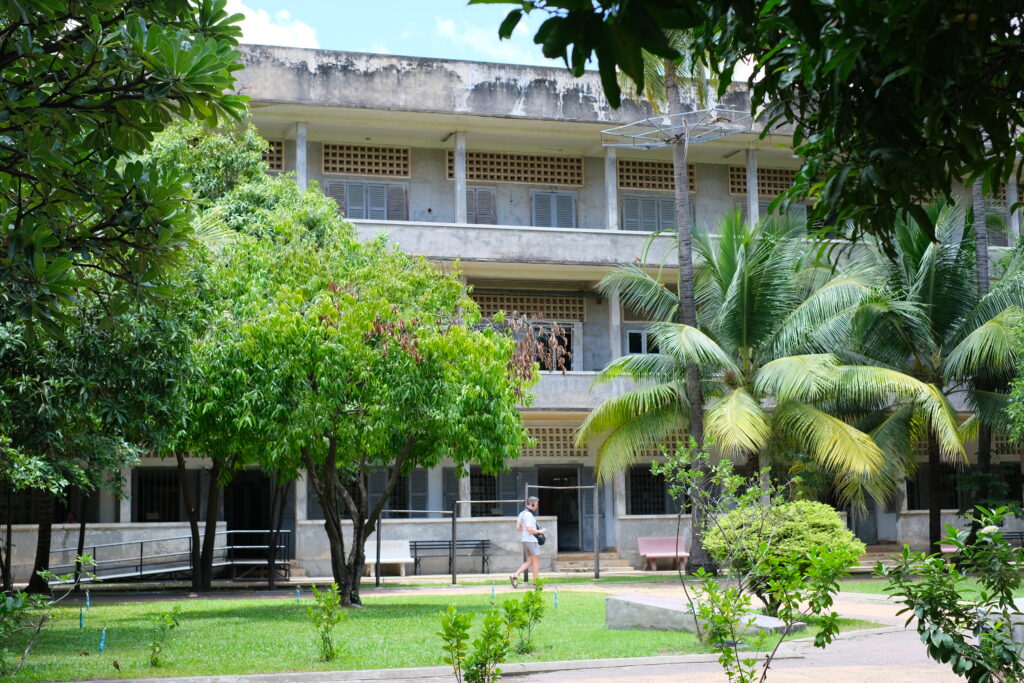
Tuol Sleng was originally an ordinary secondary school. Classrooms where children learned to write, count, and dream. But in 1975, with the rise of the Khmer Rouge, it was turned into the S-21 security prison and the most feared interrogation center in the country. Fear replaced education. Interrogations replaced laughter. Death replaced the future. An estimated 12,000 to 20,000 prisoners passed through here, of whom only a handful survived.


The complex has been left almost in its original condition. You walk through corridors where iron beds, handcuffs, and stains on the floor remain to this day.


THOUSANDS OF FACES
The staff at S-21 (Tuol Sleng) kept detailed records on each prisoner, which became key evidence after the fall of the regime.
The walls are lined with thousands of black-and-white portraits of prisoners. Looking into their eyes was the most powerful experience of my entire visit. Suddenly, you are looking into the faces of thousands of men, women, and children. Each photograph was taken shortly before their death. Those eyes look directly at you. And you simply cannot look away.


Prisoners were forced to write detailed autobiographies and extensive “confessions,” often extracted through torture. These documents, though largely fabricated, contained names, professions, family ties, and political “crimes” and were carefully archived. After the Vietnamese army captured Phnom Penh in January 1979, most of these records, including photographs and documents, were found and rescued. The original photographic negatives were later restored and preserved.
The identification of faces in the photographs was carried out in part by relatives and museum visitors in the early years after the museum opened, who wrote down the names of people they recognized in the photographs. Organizations such as the Cambodian Genocide Program (CGP) at Yale University and The Documentation Center of Cambodia (DC-Cam) also engaged in systematic identification.
COMRADE GHOST, DIRECTOR OF PRISON S-21
The fate of Kaing Guek Eav, director of the S-21 prison and known by the nickname Comrade Ghost, was sealed after a long trial. After the fall of the regime, Duch lived in hiding under a false name until he was tracked down by a journalist in 1999. He was subsequently arrested and brought before an international tribunal supported by the OSN (Extraordinary Chambers in the Courts of Cambodia, ECCC).

In 2010, he was the first high-ranking Khmer Rouge official to be sentenced to 35 years in prison for crimes against humanity. In 2012, his sentence was increased to life imprisonment after an appeal. Kaing Guek Eav died at the age of 77 in a hospital in Phnom Penh, where he was serving his life sentence. The cause of death was acute respiratory failure. His trial was a landmark moment for justice in Cambodia, although for many victims and survivors it brought only partial satisfaction.
TRIALS OF SENIOR KHMER ROUGE LEADERS
The trials of the remaining senior Khmer Rouge leaders were held before the same special tribunal (ECCC) that tried Duch. These trials were extensive, lasted many years, and led to further convictions for serious crimes.
Who were the main defendants and what were their fates?
Nuon Chea (Brother Number 2 and chief ideologist): He was found guilty of crimes against humanity in 2014 and genocide in 2018. He was sentenced to life imprisonment and died in prison in August 2019 at the age of 93, during the appeal process.
Khieu Samphan (head of state): He was sentenced to life imprisonment in 2018 for genocide, crimes against humanity, and war crimes. His appeal was rejected in September 2022, making him the last surviving and convicted leader of the regime.
Ieng Sary (Foreign Minister): He was indicted but died in 2013 before his trial was completed.
Ieng Thirith (Minister of Social Affairs and wife of Ieng Sary): She was found unfit to stand trial for health reasons (dementia) and died in 2015.
The ECCC officially ended its work in January 2022 after 16 years, handing down only three final convictions. However, its significance also lay in documenting and creating a shared historical memory for the Cambodian people. The trials of the Khmer Rouge leaders had a mixed impact on Cambodian society. For many victims and survivors, they represented a historic milestone in the process of justice and confrontation with the past, albeit with certain reservations.
We regret the killings, but we are innocent, defended the leaders of the Khmer Rouge
For many Cambodians who had lived in uncertainty for years, this meant official recognition of their suffering. Despite criticism of the length of the trials and the limited number of verdicts, the courts gave some victims a sense that justice had been done, at least in part. The trials and the evidence made public served as an important educational tool for younger generations who learned about the genocide in schools. This helps prevent the denial of history. The trials were also the subject of political controversy, particularly due to the influence of Cambodian Prime Minister Hun Sen, who himself shared a past with the Khmer Rouge and sought to influence the proceedings of the tribunal. Some Cambodians, as well as international experts, criticized the tribunal for its slowness, high costs, and limited number of convictions, which they saw as an inadequate response to such a huge crime.

I believe that despite their shortcomings, the courts have forced Cambodia to confront its unresolved past and have contributed to ending the era of impunity for genocide.
THE SILENCE THAT SCREAMS AT YOU
There is no need for much text in the museum. The atmosphere speaks for itself. In one room there are skulls, in another the testimonies of survivors. Some of the guards were themselves children raised by a regime that destroyed them too. Nothing here is black and white, but everything is terribly human.

Trees grow outside in the yard. The sun is shining. Phnom Penh is alive. And suddenly you realize that the horror did not take place “long ago,” but at a time when people elsewhere were listening to disco and deciding where to go on vacation.

Right on the premises, you can sometimes meet one of the few people who survived the hell of S-21 and buy their autobiographical book.

PRACTICAL TIPS

Admission: Tickets cost $5 for adult foreigners. We strongly recommend paying an additional $5 for an audio guide (available in many languages), which will provide you with the necessary context.
Opening hours: Open daily from 8:00 a.m. to 5:00 p.m.
Dress code: As in temples, respectful clothing is required here, i.e., shoulders and knees must be covered.
MAPA:
KILLING FIELDS IN CHOEUNG EK
But the horror doesn’t end at the museum. I left Tuol Sleng quietly. I had no idea that true silence awaited me outside the city. The Killing Fields in Choeung Ek are located about fifteen kilometers from Phnom Penh. The road there leads past houses, fields, motorcycles, and everyday life. And that is what is most terrifying about it, that the horror took place in the midst of a normal landscape.


THE END OF THE ROAD OF NO RETURN
The prisoners from Tuol Sleng were loaded onto trucks at night. They were told that they were going to another place, that they would be relocated. Instead, they arrived here. In the fields. Without trial or sentence, they were executed. To save bullets, they were killed with hoes, sticks, or bamboo poles.

When it rains, fragments of bones and remnants of clothing are said to appear from the soil to this day. Not as an attraction. As a reminder that the past is not a closed chapter here, but an open wound.


As with Tuol Sleng, I recommend using an audio guide here. It doesn’t overwhelm you with facts, but tells stories in the voices of survivors. The voices of people who lost their families, but not their ability to speak.


It’s a strange feeling. You walk among mass graves marked by inconspicuous signs. The grass is beautifully green. In the silence, you can hear birds singing. And suddenly you realize that evil doesn’t have to look dramatic. Sometimes it is quiet, systematic, and terribly effective.

TREE OF CHILDREN
Today, trees grow here. One of them was used to kill children, who were killed by being thrown against the trunk. That detail is difficult to write about. And even more difficult to read. But I think it needs to be mentioned.


MEMORIAL MADE OF BONES
In the middle of the complex stands a glass stupa. Inside, you will find thousands of skulls, stacked according to gender and age. Some still have visible cracks. As evidence that cannot be disputed.


WHY GO THERE, EVEN IF IT HURTS
The Genocide Museum is not a pleasant place to visit, but it is important. It serves as a reminder of how far ideology, fanaticism, and blind faith in a “better tomorrow” can go. It reminds us that evil does not necessarily have horns. Often, it has a stamp, a uniform, and a plan. And that is why I think you should not skip this museum. For travelers, it is a lesson in humility. You realize that Cambodia is not just Angkor Wat and cheap smoothie bowls. It is a country that bears a deep scar, and yet people smile here. And from my own experience, I have to say that it seems to me more so than in other Asian countries.

FIRST THEY KILLED MY FATHER – A STORY THAT WILL CHANGE YOUR PERSPECTIVE ON THE WORLD
If I had to recommend a single book that would help you understand this dark period in Cambodia’s history, it would be Loung Ung‘s autobiography, First They Killed My Father. The book describes the author’s childhood in Phnom Penh, which turned into a struggle for survival within a matter of hours in 1975. Loung was five years old when the Khmer Rouge occupied the city. Her family, who belonged to the urban elite, was exiled to labor camps in the countryside. The title of the book is not just a metaphor; it is the raw reality of losing her father, mother, and siblings.

This will help you understand the whole context. When you visit the Tuol Sleng Genocide Museum (S-21) or the Killing Fields (Choeung Ek), you will see more than just skulls and prison cells. Behind them, you will see the specific fates of people like Loung. Cambodians are some of the kindest people I have met on my travels. When you read about what their families went through a few years ago, their smiles and hospitality will take on a whole new dimension for you.
Unlike history textbooks, this book conveys the “emotional truth.” That includes hunger, fear, but also the incredible strength of the human spirit and family love.

If you are not readers, check out the film adaptation of the same name on Netflix, directed by Angelina Jolie. The film was shot directly in Cambodia (in Siem Reap and Battambang) and features exclusively local actors.

MY TIP:
Read the book while you’re still on the plane. When you first step off in Phnom Penh, you won’t just be tourists. You’ll be guests who know the value of the peace that reigns there today.
I visited the museum and mass graves in the morning and then sat down in a café. I watched the hustle and bustle of the city and let everything sink in. Some experiences need silence. Because traveling isn’t just about the beauty of the world. Sometimes it’s also about its darkness. And about not forgetting it.
Somehow, I didn’t feel the need to take any photos that day. Not even of myself. Not even of my surroundings. Suddenly, I began to perceive Cambodia differently. The laughter of children in the streets, monks in orange robes, and the evening bustle on the waterfront suddenly took on a new depth.
I took away from this visit a kind of heaviness, and at the same time a strange gratitude. For being able to leave. For being able to think freely, ask questions, and doubt. Cambodia is not a country of victims. It is a country of survivors.

If you liked the article, I would appreciate it if you shared it or left a nice comment below the article.

I would also like to invite you to join me at Instagram and Facebook.

OTHER ARTICLES FROM CAMBODIA
