
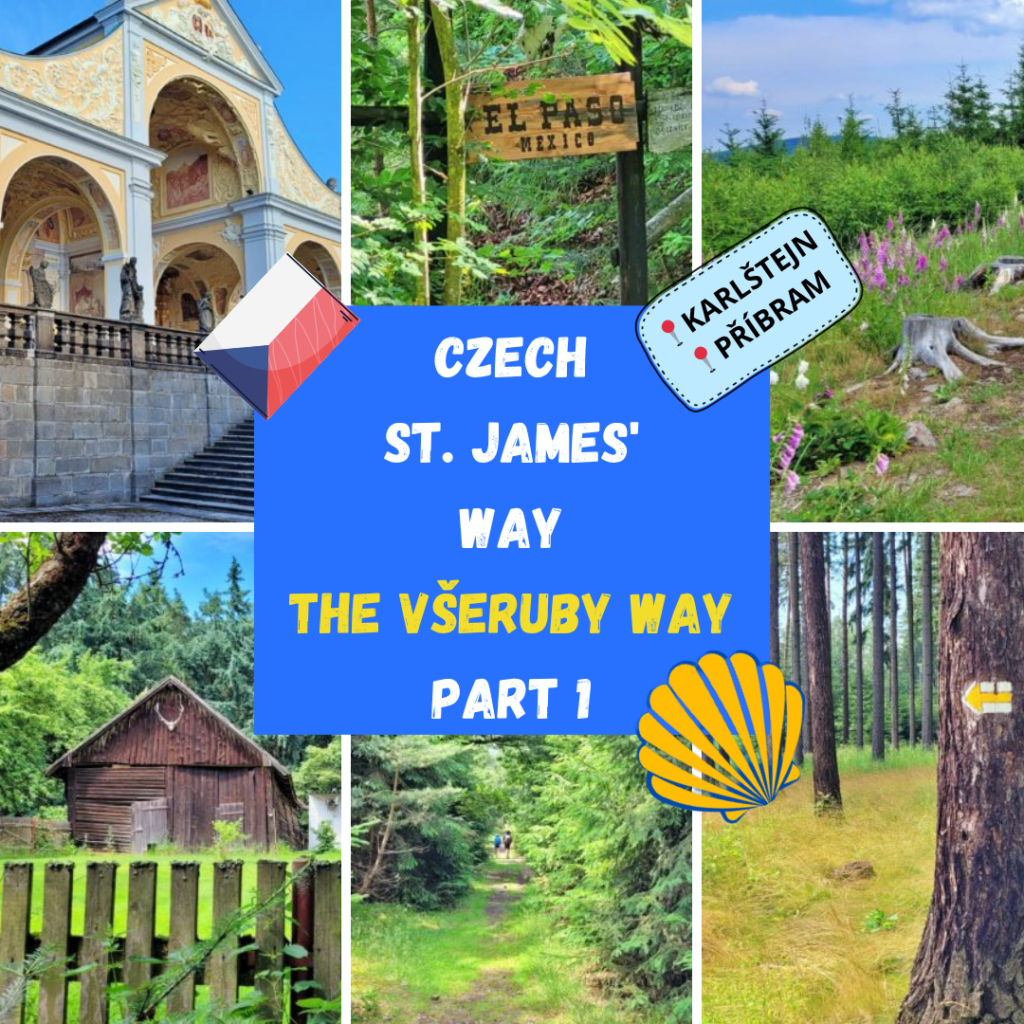
🚸ROUTE:📍KARLŠTEJN -📍PŘÍBRAM -📍NEPOMUK -📍KLATOVY -📍KDYNĚ -📍VŠERUBY (total 214 km)
We have a problem here – “modern pilgrimage”. In the past, pilgrims set out for purely religious reasons, but today I would say that modern pilgrims set out on a journey to find hope. Hope that they will overcome something or clarify something. Or they simply want to prove to themselves that they are healthy and full of energy to complete the entire route. And why did I set out on the journey? I think that each of us pilgrims carries our own “shit package” in our backpack. 🙂

MY ADVICE:
Don’t be discouraged if you don’t make it! Sometimes it just happens that not everyone makes it. For many people who do, however, the pilgrimage becomes one of the most significant experiences of their lives.
🚸ROUTE: 📍KARLŠTEJN -📍HALOUNY -📍EL PASO -📍KYTÍN –
📍DOBŘÍŠ -📍PŘÍBRAM
CLICK ON THE MAP:
The Všeruby way in the Czech Republic leads from the Church of St. James in Prague’s Old Town and heads southwest to Bavaria. However, I have already walked from Prague to Karlštejn once with my family, so I decided to start my journey here. Karlštejn can also be beautifully symbolic like Prague. I won’t lie to you, but the path is difficult in places, but believe me, after a few kilometers you will start to enjoy it. In short, you will get used to everyday walking. The important thing is not to burn it out right at the beginning. This can easily happen to you, because one of the sections passes through a large part of the Brdy Mountains. The path leads through beautiful pilgrimage sites such as Svatá Hora, Nepomuk or Tanaberk. You will reach the border crossing between the Czech Republic and Germany.

And how long can the journey take you? Be sure to adapt the journey to your physical abilities. It is not written anywhere that you have to walk 30 km every day. And you can also take a break somewhere for a day. There are many places on the route that are nice to walk the whole way or just stop in the forest and enjoy the beautiful nature. In short, it depends only on you. I have divided the article the way I walked the journey. So let yourself be inspired.
🚸 ROUTE: KARLŠTEJN – DOBŘÍŠ (22,8 km)
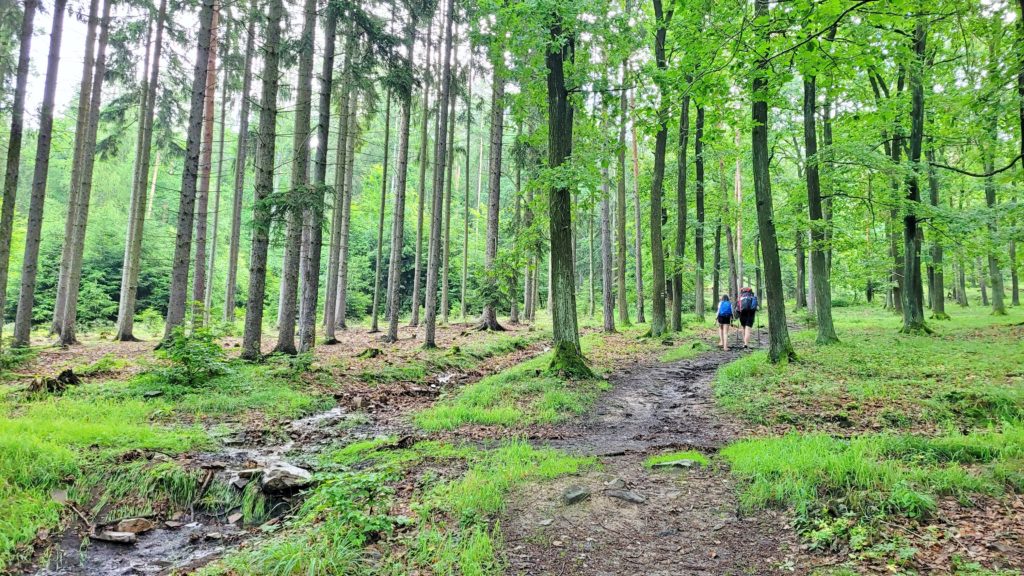
This road leads across the Berounka River, part of the Brdy Mountains, through the villages of Hlásná Třebáň, Zadní Třebáň, the settlement of Halouny to the village of Dobříš.
HALOUNY
Halouny is a tramp village. Tramps from here regularly went on hikes to the Brdy Mountains on Fridays and Saturdays. And they also founded their settlements in the surrounding area. Unfortunately, these settlements were mostly destroyed in the previous regime. However, I decided to take a peek at one of them. However, do not forget that these are private lands.

TRAMP SETTLEMENT El PASO
This oldest tramp settlement in the Brdy Mountains is located on a beautiful romantic site of the original quarry. The settlement was founded by three settlers from the former Westend settlement in 1925. The oldest hut is called EL PASO. The most beautiful view of it is from the height of the monument to J. Maršálek. The settlement is also named after it. The first settlers carried clay here in bags on their backs. The clay pier created in this way allowed access to the lake, around which the settlers gradually built log cabins.


BRDY’S WINTER ARMY
Just above the El Paso hut, the Brdy’s Winter Army was formed under the command of General Jerry Packard. Today, one could say that they were pioneers of winter camping. This group even had its own uniform, consisting of a “three-cornered” hat, corduroy pants, Milton sweaters and coats. 🙂

KYTÍN
Through the Brdy Forest you will reach a beautiful picturesque village called Kytín. There is a church here, which is dedicated to the Assumption of the Virgin Mary. In the 1960s, there was also an organ from nearby Skalka, which J. J. Ryba could play on. Around the church there is an old cemetery surrounded by a wall, but no burials have been made there for 150 years. Behind the church there is a spring that has been revered for over 500 years as miraculous, healing eye diseases..


The local landscape entered the wider subconscious of people in the early days of tramping, and several famous figures are associated with Kytín. The most famous is certainly the literary figure of the schoolboy Kája Mařík, whose stories were created in the beautiful scenery of the Kytín Forests.

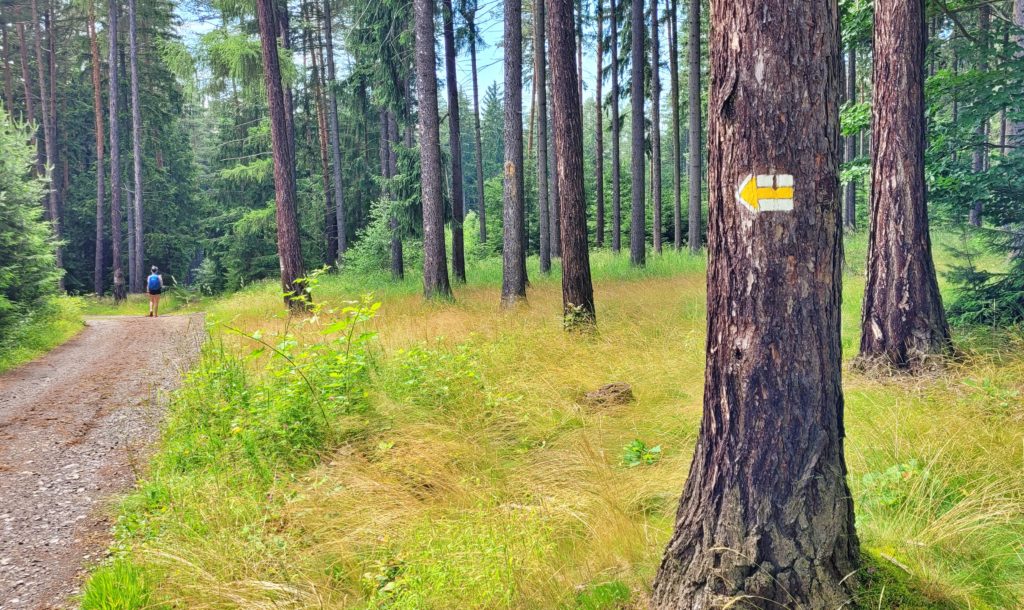
From Kytín, the remaining 11 km follow the yellow path again through a forest, sometimes also fir. Then continue along the blue path, first through a coniferous and then an oak forest, heading straight to Dobříš.
DOBŘÍŠ
The name of the town of Dobříš is said to be derived from the name of Lord Dobřich, who founded the settlement on the trade route. In the 14th century, Dobříš served as a favorite hunting ground for the Czech kings.
DOBŘÍŠ CASTLE
Today, Dobříš is also known for its Rococo chateau. It is a chateau not only of aristocrats, but also of writers and filmmakers.
The chateau belonged to the noble family Colloredo – Mannsfeld, who lived here until 1942, when the chateau was expropriated by the German Reich, which meant that they were actually enemies of the empire. The protector Kurt Daluege lived here. Then came the liberation, the Colloredos were here for a while, but communism came, the chateau was confiscated by the Czechoslovak state, so they had to emigrate. The chateau was used as a Writers’ Home, which is the fault of the writer Jan Drda, a native of nearby Příbram. However, the writers did not have much luxury here. At that time, the aristocratic residence still did not have central heating, with shared toilets and bathrooms in the hallway. Not only writers lived in the chateau, but also cultural figures. For example, the star of the First Republic, Adina Mandlová. She more or less lived out her life here. She spent a few moments here at the end of her life and remained a lady until her last breath. The actress was given a room on the ground floor of the east wing of the castle, where the director’s secretariat is today. She died in the Příbram Hospital. She was 81 years old.
The current owner of the castle is Dipl. Ing. Jerome Colloredo-Mannsfeld from Austria, to whose ownership it returned in 1998.
The castle is also popular among filmmakers. Zdeněk Troška filmed the fairy tale The Mill Princess here. One of the largest productions that was here was the crew of the film Shanghai Knights with Jackie Chan.
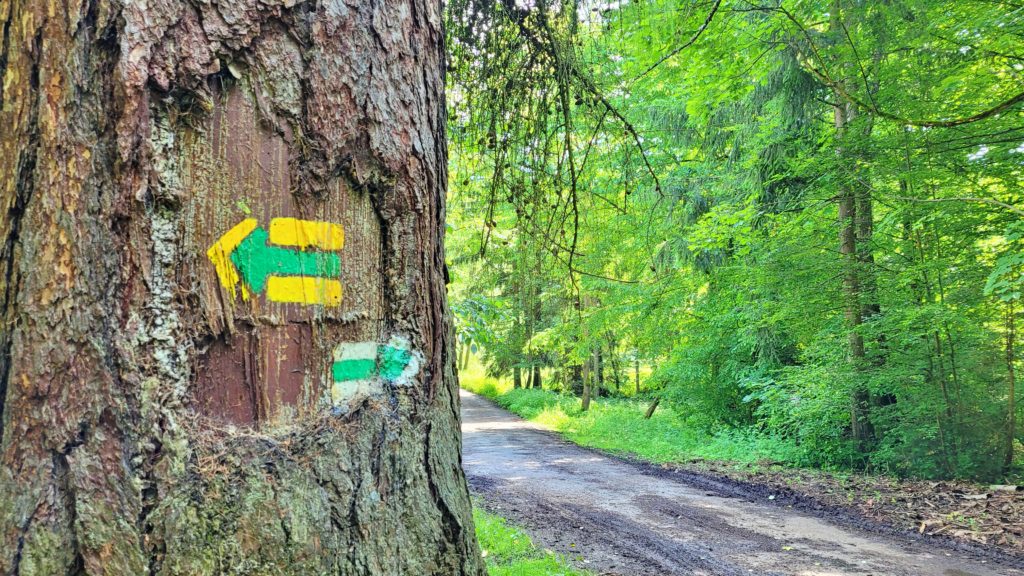
🚸ROUTE DOBŘÍŠ – PŘÍBRAM (Length: 26,6 km)
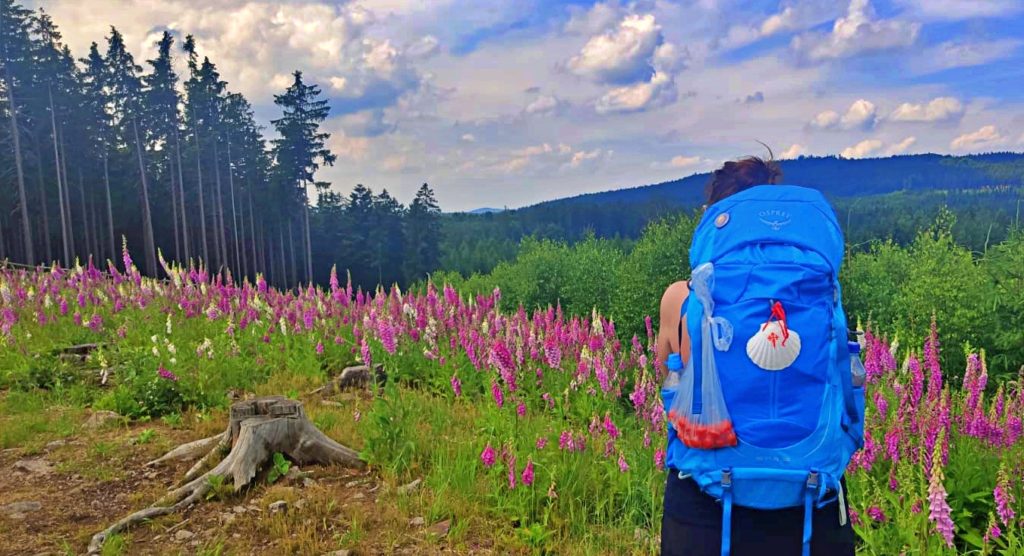
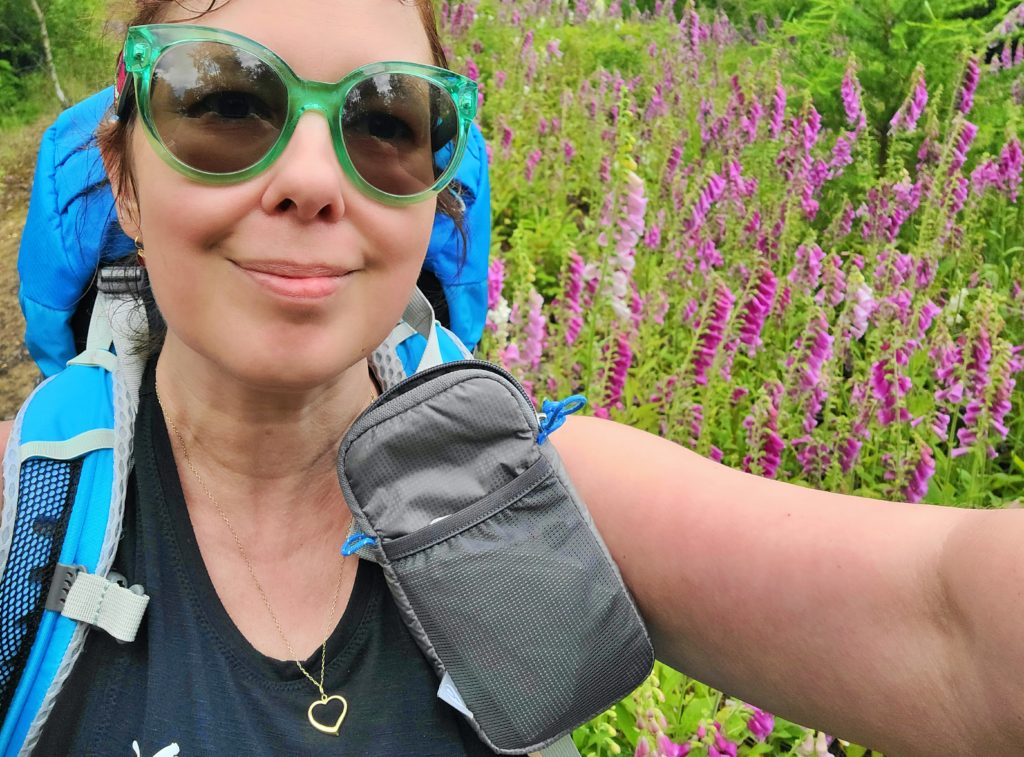
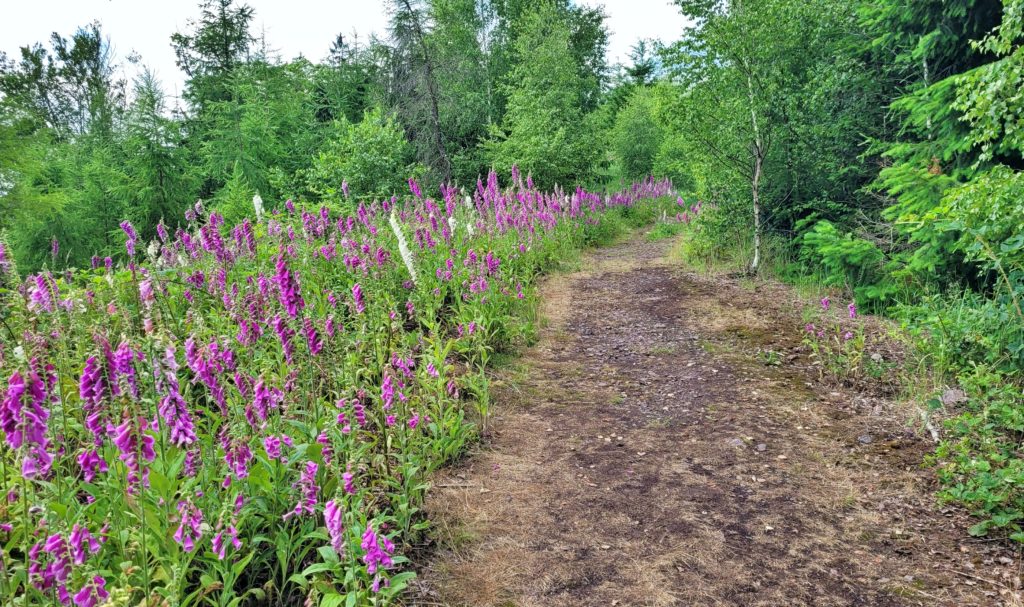
From Dobříš, the pilgrimage route leads in a kind of arc through the Brdy forests. It is almost outside civilization, so you better take that into account and take something to eat and drink with you. The nature here is very beautiful. If you walk the route like I did in the summer, you will come across a growing foxglove.


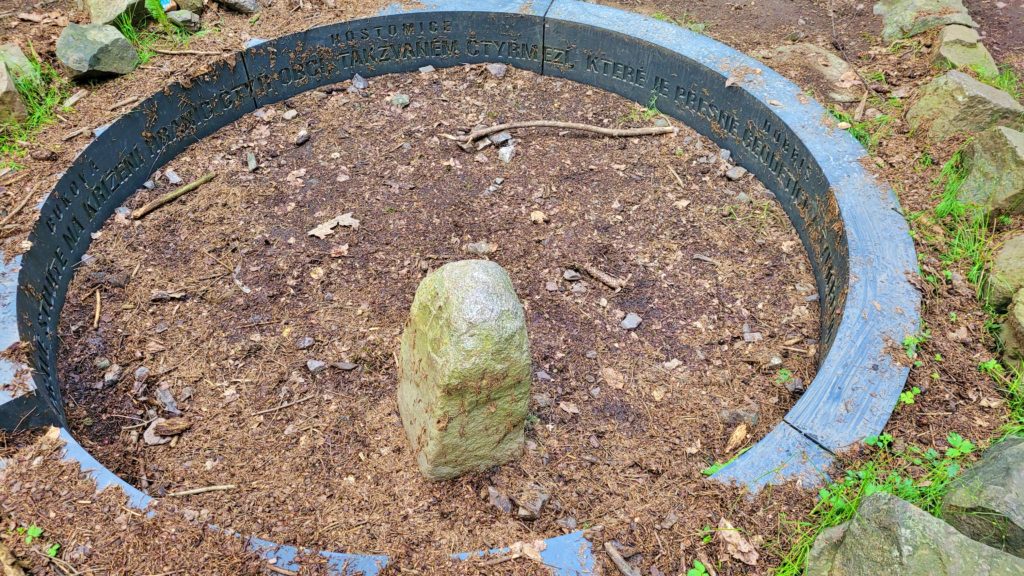

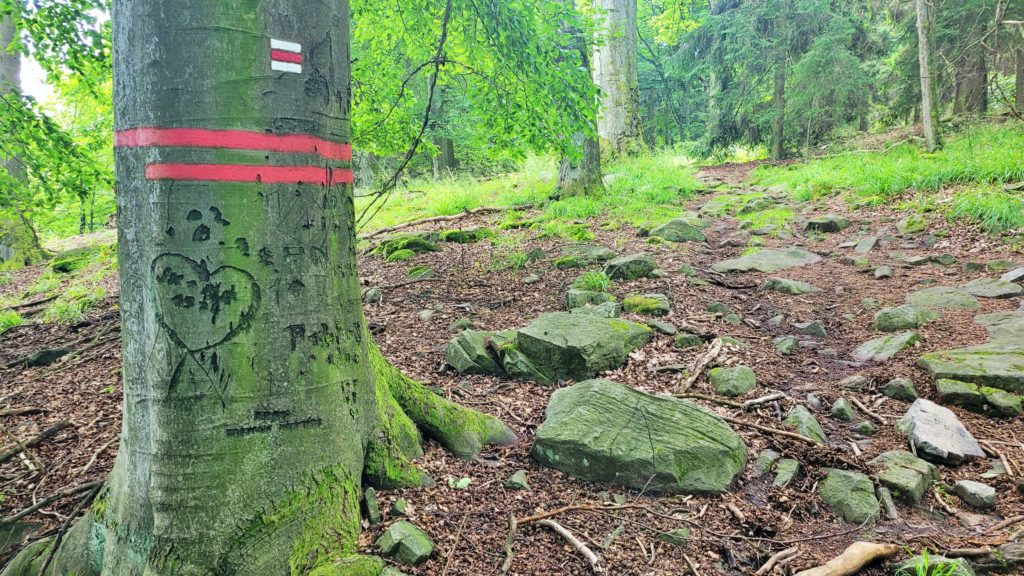


You will climb to the top of Kuchyňek and slowly descend through the forest to Příbram. I have to admit that I originally thought I wouldn’t do this section because it seemed too long and demanding at the beginning, but in the end it was really nice. The Brdy nature is truly beautiful and it is definitely worth overcoming all your fears. You would miss one of the most beautiful parts of the Všeruby St. James’ Way. Just remember that there are no restaurants along the way, so bring your own food!


A beautiful flower, a joy to look at, isn’t it? But although it looks defenseless, it is a great danger to other plant species, especially meadow species. While foxglove grows like mushrooms after the rain, it displaces other native species.


HOLY MOUNTAIN
Following the Holy Mountain Stairs (365 steps to heaven) and the picturesque streets of old Příbram, you will reach a truly amazing architectural complex. Holy Mountain is a significant Baroque site and a place of pilgrimage.


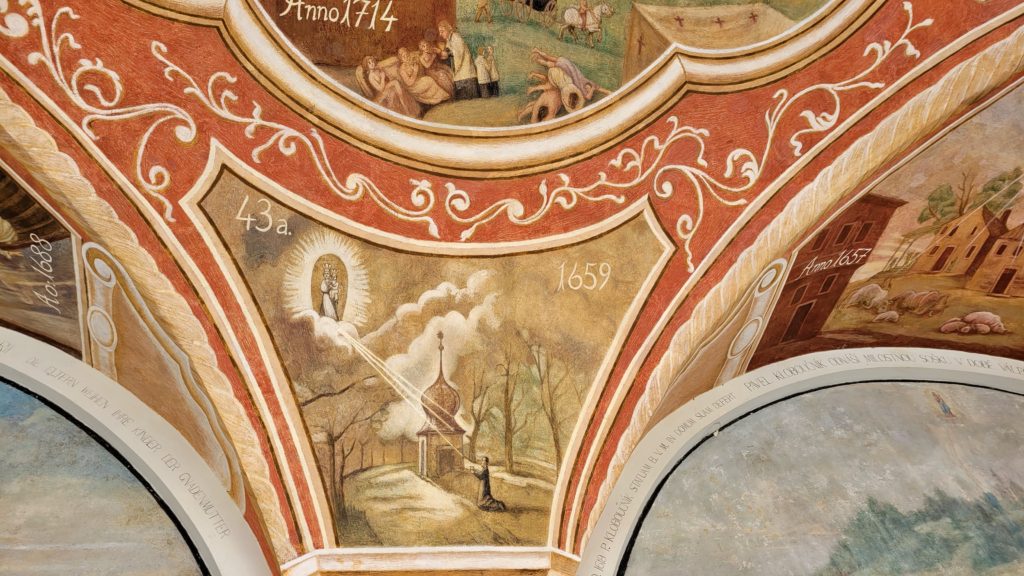
Around the perimeter of the entire area there are cloisters – or vaulted corridors, the ceilings of which are decorated with paintings. They contain scenes describing the miracles performed by the Virgin Mary, including the year and number under which the respective miracle is recorded in the local Book of Grace. According to the Holy Mountain documents, more than 4,000 miracles took place over the city of Příbram. However, these are only those historically documented and approved by the Vatican.

In the corners of the cloisters there are four octagonal chapels named after the cities – Plzeňská, Pražská, Mníšecká and Březnická. The stalactite chapel of St. Mary Magdalene is particularly unusual.

There is a place reserved for the statue of the Virgin Mary on the altar. The baby Jesus in her arms has dark cheeks. The originally light pear wood has gradually darkened over the centuries. The statue is traditionally dressed in specially sewn clothes. One of them was given to the statue by Empress Maria Theresa herself, sacrificing part of her wedding dress for it.


ACTION K
AND
THE STATUS OF THE NOBILITY AFTER 1945
On the Holy Mountain you will also find an exhibition dedicated to Action K and the position of the nobility after 1945. Action K (K as monasteries) was part of the communist party’s efforts to liquidate church orders. On the night of April 13-14, 1950, the state seized the male monasteries and the monks were taken to internment. The exhibition contains information specifically related to the Holy Mountain. In 1949, Jan Blesík and Ivan Mastiliak were arrested by the communists. They were sentenced to many years in prison in a fabricated trial. This small exhibition is definitely worth seeing. We should not forget our past!

The Stations of the Cross in the park on Svatá Hora was created in the 1930s. It is about 0.8 km long along a linden alley, lined with rare trees such as plane trees, yews and red beech.
JOSEPH TOUFAR’S CROSS
After the Velvet Revolution, the cross of Josef Toufar, a priest who is associated with the so-called Čihošť miracle, was placed on Svatá Hora.


If you liked the article, I would be happy if you share it or leave a nice comment below the article.

I would also like to invite you to join me on Instagram and Facebook.