

When people think of Asian cuisine, most think of Thai spiciness, Vietnamese freshness, or Chinese diversity. Cambodia, or the ancient land of the Khmer people, stands somewhat apart. And that’s a shame. Because Khmer cuisine is very delicate and in no way needs to compete for attention. I am sure it will win you over with its subtlety, harmony, and flavors. And in the end, you will discover that its strength lies in its unobtrusiveness.
KHMER GASTRONOMY IS BASED
ON A SIMPLE PHILOSOPHY: BALANCE
Don’t expect an explosion of chili that will take your breath away. Cambodians prefer subtlety and the natural flavors of ingredients. Spices are used to enhance the food, not overwhelm it. Rice is the staple food. It is eaten with practically everything, morning, noon, and night. In Khmer, there is even an expression “Are you going to eat rice?” instead of our “Are you going to eat?”. Rice is served with vegetables, fish, chicken or pork, and lots of herbs. Coconut milk, lemongrass, galangal, turmeric, and kefir lime leaves play a very important role.

FRENCH FOOTPRINT
Cambodia was long part of French Indochina, and French influence is still evident in its cuisine today. This is most noticeable in baked goods. Crispy baguettes called “Noam Pang” are a common part of street food and are filled with meat, vegetables, and sauces. It is a Cambodian version of the well-known “Bánh mì.” The French also left behind a love of coffee. It is often prepared strong and sweet, with condensed milk. The ideal combination for a slow morning wake-up.

KHMER CUISINE DURING THE REIGN OF THE KHMER ROUGE
During the Khmer Rouge regime (1975–1979), traditional Khmer cuisine was practically destroyed and replaced by a survival diet. Gastronomy was reduced to collective dining, the aim of which was to keep the population on the brink of life, while most of the rice grown was exported. The basis of the “diet” was extremely thin rice porridge (bobor) with a large amount of water and a minimum of grains. Often, only rock salt was added to it.

Private cooking and ownership of kitchen utensils were prohibited. People had to eat in community canteens, where they received rations according to the type of work they did. Extreme food shortages forced people to eat whatever they could find in nature. Insects, spiders (tarantulas), frogs, snakes, snails, and rats thus found their way into the diet. Fried a-ping spiders, now a popular street food, are a direct remnant of this period. Many traditional recipes, especially those from the royal palace, were almost forgotten because the bearers of these traditions were persecuted and written records were destroyed.
COOKING CLASSES IN SIEM REAP
It’s one thing to taste Khmer cuisine and quite another to learn how to cook it. In Siem Reap, a city of temples but also of good food, cooking classes are among the best experiences you can take away from your travels. Because you won’t just take home memories, you’ll take home the taste of Cambodia.

Cooking classes in Siem Reap are not just classes. They are gatherings. Instructors talk about life in Cambodia, family recipes, what is cooked on holidays and what is cooked every day. You often cook in a small group or even in a family home. Of course, the best part is the food, when you sit at the table and a plate you just prepared yourself lands in front of you. You taste it and suddenly it starts to taste better than in a restaurant. Maybe it’s because you know how much lemongrass and chili you had to chop. Maybe it’s because you understand that Khmer cuisine is not just about recipes, but also about patience.

I always try to attend cooking classes when I travel, because they teach me about local ingredients and how to combine them, and I get to experience the local market from a different perspective. Above all, I get to meet local people and gain a deeper understanding of the local cuisine. Because tasting is fine, but cooking means understanding.
THE DAY BEGINS AT THE MARKET
Most cooking classes begin, as they should, at the local market. And that is an experience in itself. You walk among piles of herbs, vegetables, and spices. The air is filled with the scent of lemongrass, fresh coriander, and sometimes even prahok, a fermented fish paste that can test the character of any traveler.


The instructor will explain what galangal is. And also why it is not ginger. Or how to recognize fresh turmeric and why Khmer cuisine is based on herbs and not chili peppers. Suddenly, you will realize that the market is not chaotic. It is a colorful textbook of flavors.


WHY IS KHMER CUISINE BASED
ON HERBS RATHER THAN CHILLIES?
THE LEGACY OF THE ANGKOR EMPIRE
Khmer cuisine is one of the oldest in Southeast Asia. During the heyday of Angkor (9th–15th centuries), flavors were defined by local ingredients that grew in the jungle and around Tonlé Sap Lake. Chili peppers did not arrive in Asia until the 16th century, brought by Portuguese traders.

RESPECT FOR RAW MATERIALS
Cambodia is a country of freshwater fish and rice. The Khmer people believe that food should taste like what it is made from. Too much chili would mask the delicate flavor of fresh fish from the Mekong River. Herbs are used to bring out and complement the flavor, not to overwhelm it.

While neighboring Thailand and Vietnam often “hit” you with the heat of chili peppers, Cambodian cuisine (Khmer) is more about depth, texture, and layering of flavors.
WHAT TO LOOK FOR IN THE “TEXTBOOK” MARKET
If you look at the Khmer market not as chaos, but as a textbook, you will begin to perceive a logic that goes back thousands of years.
IN CAMBODIA, THE RULE IS: IF IT DOESN’T SMELL STRONG, IT’S NOT AUTHENTIC.
PRAHOK: FERMENTED FISH PASTE
Prahok is a fermented fish paste and for the Khmer people it is what Parmesan cheese is to Italians or sauerkraut to Czechs. It has a very distinctive smell. So distinctive that when you smell it for the first time, you may want to check if someone has forgotten to take out the trash somewhere nearby. But beware. Prahok is not the enemy. It is the flavor base of many dishes and adds depth to them.
Once you get over the initial culture shock, you will find that without it, the dishes would be only half as good.
KROEUNG: BASIC PASTE
What you see in mortars at the market is not just a mixture of spices, it is the soul of Khmer cuisine. Kroeung is an herbal paste that forms the basis of almost everything. Instead of relying on heat, Cambodians build flavor using lemongrass (freshness), galangal (ginger-like sharpness), turmeric (color and earthiness), kefir limes (aroma), garlic, and shallots.

GALANGAL: NOT GINGER
Galangal is an aromatic root that is very similar to ginger, but also to turmeric. It has a sharp, citrusy-peppery flavor with a hint of pine. It is used in curry pastes and soups. It resembles ginger, but has a smoother, lighter to pinkish skin and is much harder and more aromatic.

FINGERROOT: KNOWN BY ITS THAI NAME KRACHAI
Fingerroot is known by its Thai name, krachai. Its shape resembles a cluster of long fingers. It belongs to the same family as ginger. It has a milder, earthier, and slightly peppery taste than regular ginger. It is considered an irreplaceable ingredient, especially for its ability to mask the “fishiness” in seafood and freshwater fish dishes. In folk medicine, it is used to aid digestion, relieve flatulence, and as a natural aphrodisiac. It contains substances with anti-inflammatory and antibacterial effects.

KAMPOT PEPPER
Cambodian pepper, better known as Kampot pepper, is considered one of the best and highest quality peppers in the world. It is protected by a geographical indication. In the Czech Republic, it is commonly available in various online stores and specialized brick-and-mortar shops.
Kampot pepper is easy to find in Czechia. You can find it, for example, in these online stores:
Kampot.cz: This online store specializes exclusively in genuine Kampot pepper and spices from Cambodia. It offers a wide selection of different types (black, red, white).
Pepperfield.cz: Another specialized retailer offering various types of Kampot pepper, including white pepper with notes of camphor and citrus. Reviewers appreciate the quality and the story behind the pepper.
Khmer-pepper.cz: An online store importing certified Kampot pepper of the highest quality with a protected geographical indication (PGI).
You can learn more about Cambodian pepper in my article:

COOKING IN THE KHMER STYLE
After returning from the market to the kitchen, the main part begins. Cooking here is calm, without stress or rush. It is based on the harmony of contrasting flavors: sweet, sour, salty, and spicy. Freshness and aromatic herbs are important. Fish and meat are often grilled or slowly stewed in coconut milk with palm sugar. The flavors are balanced with fish sauce, palm sugar, and tamarind (for sourness). Cambodian dishes are much less spicy and are usually seasoned with chili peppers. Coconut milk is also widely used in this cuisine. And I really like that. Almost every meal is served with rice in a bowl as a side dish.
Cambodian (Khmer) cuisine is varied and fresh, and you will most often encounter these iconic dishes:
Fish Amok: A national treasure consisting of fish fillets in a creamy coconut curry, steamed in banana leaf baskets.
Beef Lok Lak: Sautéed beef pieces served on a bed of fresh salad, tomatoes, and onions, accompanied by a sauce made from lime and Kampot pepper.
Nom Banh Chok: A traditional breakfast dish consisting of rice noodles topped with green fish curry with herbs and fresh vegetables.
Bai Sach Chrouk: A simple but popular dish of grilled pork marinated in garlic and coconut milk, served with rice and pickled vegetables.
Kuy Teav: A nutritious noodle soup with meat broth, herbs, bean sprouts, and often pork or seafood.
Khmer red curry: Milder and less spicy than Thai varieties, usually with beef, chicken or fish and sweet potatoes.
Kampot Pepper Crab: A specialty from the coastal town of Kep, where fresh crabs are roasted with green balls of world-famous Kampot pepper.


MY TIP:
If you are hesitating whether to take a cooking class, the answer is simple: “YES.” You will bring back photos from Angkor, but when you attend a cooking class, you will bring back a skill. And every time you prepare amok at home, you will return to Cambodia for a moment. I recommend visiting the market in the morning to cook lunch. The reason is clear: you will visit the local market.
I have chosen two fairly simple recipes for you. I learned them during a cooking course in Cambodia.
MANGO SALAD
For 3-4 servings
What you will need:
1 mango
1 carrot
20 g fresh basil
1 tablespoon roasted peanuts
3 coriander leaves
1 small teaspoon chili peppers to taste
Dressing:
½ small teaspoon sweet paprika
lemon juice
2 cloves garlic
1 ladleful of water
1 small teaspoon chicken powder
1 small teaspoon brown sugar (if you are sugar free, you can omit this)
Procedure:
Preparation is simple and does not take much time. First, finely grate the mango, carrot, coriander, basil, and chili pepper. Put everything in a large bowl together with the roasted nuts. In another bowl, mix the sweet paprika, lemon juice, crushed garlic, chicken powder, and brown sugar with a ladle of cold water.

Mix the salad with the dressing at the last minute, just before the main course is ready.

AMOK FISH:
A NATIONAL TREASURE ON A PLATE
If there is one dish you should try in Cambodia, it is fish amok. At first glance, it looks unassuming. It is served in a bowl or banana leaf and resembles a delicate pudding. But once you taste it, you will understand why it is considered a national treasure. Amok is made from fish, coconut milk, and a spice mixture called kroeung. The mixture is stewed or steamed to create a creamy, delicate texture.
The taste is light, fragrant, and surprisingly elegant. There is no aggressive spiciness, just harmony. After the first bite, you feel like someone has figured out how to cook soup, curry, and dessert all at once. It is, of course, served with rice, and it is truly delicious!

First, you need to make the curry paste.
KROEUNG PASTA
What you will need:
5 dried chili peppers (soaked)
1 stalk of lemongrass
10 g galangal
10 g ginger
6 kaffir lime leaves
6 cloves of garlic
2 shallots
10 g fresh turmeric root (or 1 teaspoon turmeric powder)
30 ml olive oil
Procedure:
Remove the stems from the chili peppers. Cut them lengthwise with a knife and remove the seeds. Soak them in hot water for 2 minutes to soften them. Drain the water and chop the peppers coarsely.

In a mortar, grind the chili pepper, lemongrass, galangal, ginger, lime leaves, garlic cloves, shallots, turmeric, and oil into as smooth a paste as possible. You will need to grind for a while to achieve a smooth, uniform consistency. If you don’t have the patience for this, just put everything in a blender. 🙂


SAMOTNÝ AMOK
600 g white fish
30 ml fish sauce
600 ml coconut milk
30 g brown sugar
30 ml olive oil
1 fresh chili pepper
Method:
Once you have made the paste, heat 1 tablespoon of olive oil in a pan. Add the paste and fry for about 1 minute.


Then add coconut milk, sugar, and fish sauce and simmer for 5 minutes. Cut the fish into small pieces.


Sprinkle the fish with flour, salt, and pepper, and fry in olive oil in another pan until crispy. Add the mixture from the second pan to the first pan and simmer for another 5 minutes.

Chop some fresh carrots to garnish the whole mixture. And that’s it. Amok is served with rice. You will often find it served in banana leaves.

I really love this recipe. Once you try it, I’m sure you’ll love it too! 🙂

SOUPS: WHICH ONES ARE HEALING
Cambodians love soups. And not just when they are ill, but at any time of day. One of the most popular is samlor machu, a sour soup with pineapple, tomatoes, herbs, and often fish. The taste is fresh and light, ideal for the tropical heat.

Another classic dish is kuay teav, a noodle soup similar to Vietnamese pho. You will find it mainly in the morning on the streets, where locals eat breakfast on small plastic stools. The broth is cooked slowly for a long time, and that is where its magic lies.
Cambodians believe that a good soup can lift your spirits, settle your stomach, and improve your life. After a few days in the heat and humidity, you will begin to agree with them.
STREET FOOD: THE HEART OF KHMER CUISINE
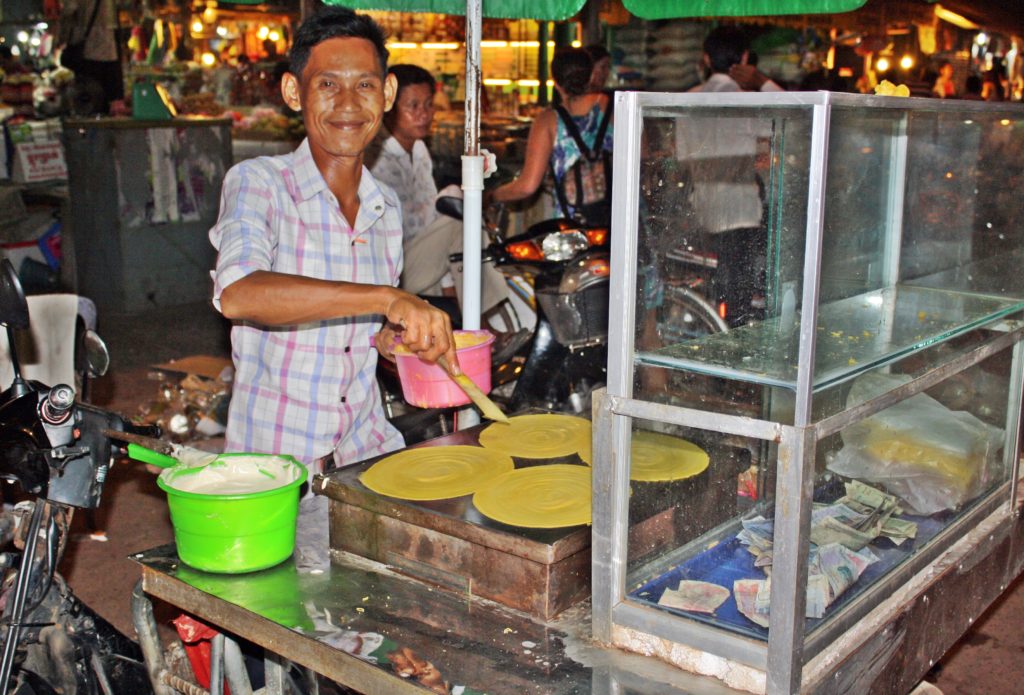
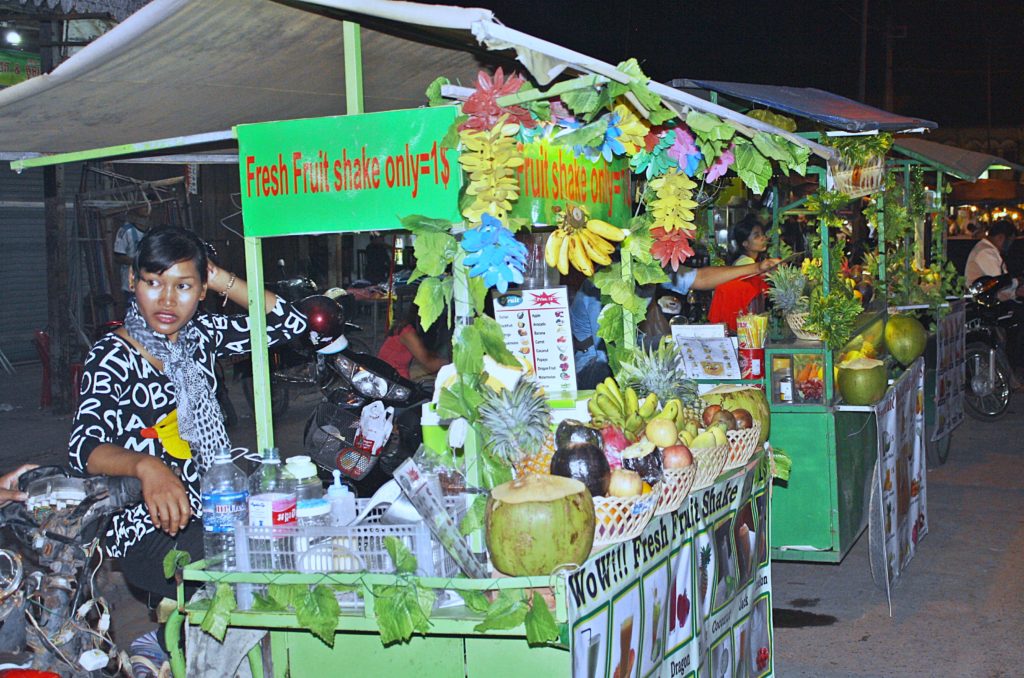
The best food in Cambodia is often not found in restaurants, but on the street. Evening markets are full of aromas, smoke, and sounds. Meat, fish, and vegetable skewers are roasted on grills. Stuffed baguettes, rice flour pancakes, fresh fruit, and sweet coconut milk desserts are sold. And then there are specialties for the more adventurous travelers. Yes, we’re talking about fried spiders, grasshoppers, and larvae. Don’t worry, no one is forcing you to try anything. But if you decide to give it a go, you’ll find that they taste more like crispy chips than a nightmare from a nature documentary.
MY TIP:
When you are in Cambodia, don’t just look for restaurants for tourists. Sit where the locals eat. Order food you don’t know. Smile and be curious. Khmer cuisine may not dazzle you, but I am sure it will slowly win you over. It won me over permanently.
THE KITCHEN AS A REFLECTION OF THE LAND
Khmer cuisine is just like Cambodia itself. Unassuming, yet profound. It doesn’t make a big impression, but if you give it time, you will discover its layers. It is the cuisine of people who value simplicity. People who can create a meal from just a few ingredients that will warm you up, fill you up, and calm you down. It may not impress you on the first day. But on the third or fourth evening, you will realize that you miss its flavors. And that is precisely its charm.

If you liked the article, I would appreciate it if you shared it or left a nice comment below the article.

I would also like to invite you to join me at Instagram and Facebook.

MORE ARTICLES FROM CAMBODIA

